
Report Board
SpaceX IPO and Space Stocks: RKLB Upside, Proxy Risk, and Dilution
SpaceX's IPO filing validates the space category, but it can also compress proxy premiums. RKLB remains high quality, yet valuation and the $3B ATM make the setup more complex.
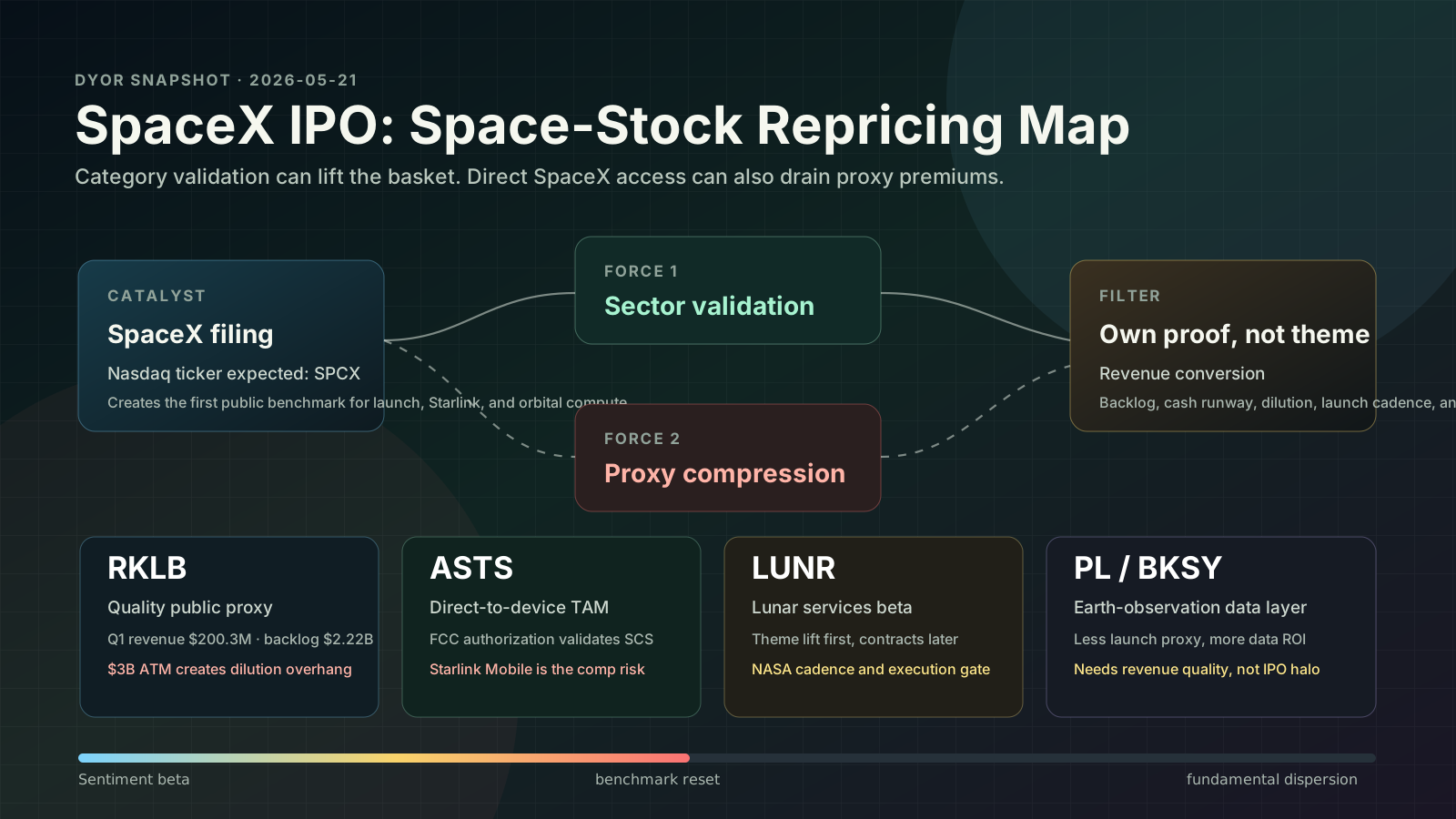
A Reviewable Logic Chain
Each card stays open and maps one transmission node without collapsible controls or pseudo-precise scores.
SpaceX IPO filing SpaceX 首次公开募股申请
The S-1 lets investors price SpaceX launch, Starlink, government work, and AI/orbital-compute optionality through a public-company lens.
S-1 让投资者通过上市公司视角,评估 SpaceX 发射、Starlink、政府工作以及人工智能/轨道计算的可选项性。
Sector attention expands 板块关注度扩张
ETFs, retail investors, and growth funds reopen the space-stock screen, lifting beta before separating winners.
ETF、散户和成长资金会重新筛太空股,先拉动 beta,再寻找可交易的二线标的。
Proxy premium resets 替代品溢价重置
Once the leader is tradable, substitutes cannot rely on scarcity alone. RKLB must be valued as an independent space-infrastructure compounder.
当龙头本身可买,替代品不再只靠主题稀缺性。RKLB 必须从 SpaceX proxy 变成独立太空基础设施复合增长公司。
Starlink / Starship yardstick Starlink / Starship 标尺
ASTS faces Starlink Mobile, and launch peers face the Starship cost curve. Every public company is calibrated against a stronger benchmark.
ASTS 要面对 Starlink Mobile,发射同业要面对 Starship 成本曲线,所有公司都会被更强公开 benchmark 校准。
Execution over narrative 兑现优先于叙事
Future dispersion depends on revenue conversion, gross margin, cash runway, dilution, contract execution, and customer concentration.
之后分化看收入转换、毛利、现金 runway、稀释、合同可执行性和客户集中风险。
Investment Question: Space Beta or Valuation Vacuum?
The first-order reaction to SpaceX's S-1 is obvious: the space sector finally gets a publicly traded leader with scale, brand power, launch dominance, Starlink, NASA relationships, and a broader AI/orbital-compute narrative. Public space stocks have mostly been partial exposures: Rocket Lab for launch plus space systems, AST SpaceMobile for direct-to-device, Intuitive Machines for lunar services, and Planet Labs or BlackSky for Earth-observation data.
The harder question is not whether space stocks can rally. It is whose valuation logic changes. A SpaceX IPO is both category validation and capital reallocation. Validation raises attention. Reallocation compresses the scarcity premium previously embedded in public proxies. Short term, the basket can move together. Medium term, dispersion should matter more.
First Principles: A Public Anchor Reallocates Capital
Public markets need a tradable anchor. If SpaceX lists as SPCX, investors no longer have to assemble a space-economy exposure through RKLB, ASTS, LUNR, PL, or BKSY. They can buy the category leader directly. Analysts can build a public SpaceX model, ETFs can own the leader, and retail investors get the most intuitive access point.
That is positive for the industry but not automatically positive for every substitute. Some capital has owned RKLB not only because it wanted Rocket Lab, but because it wanted public SpaceX-like exposure. Once the real leader is listed, that capital will compare the smaller high-beta proxy against the actual leader. That is proxy-premium compression.
RKLB: Sector Validation Helps, Proxy Scarcity Hurts
Rocket Lab's quality is real. Q1 2026 revenue was $200.3M, up 63% year over year. Backlog reached $2.22B. Cash and marketable securities were about $1.48B. Electron execution, Space Systems revenue, Neutron optionality, and vertical integration put it above most post-SPAC space companies.
The issue is valuation. StockAnalysis showed RKLB at $134.28 at the May 20 close, around $77.71B of market cap, and about $679.6M of TTM revenue. That already capitalizes a very clean future: Neutron works, Space Systems keeps scaling, government and commercial contracts compound, margins improve, and dilution remains manageable. SpaceX strength can lift RKLB, but direct access to SpaceX reduces Rocket Lab's relative scarcity.
The $3B ATM: Rational Financing, Real Overhang
Rocket Lab's May 20 prospectus supplement covers up to $3B of common stock and includes forward-sale and collared-forward structures. From management's perspective, raising potential capital into a major share-price re-rating is rational. Neutron, manufacturing scale, acquisitions, and working capital can all use dry powder.
For shareholders, the meaning is different. An ATM does not mean $3B is sold immediately, and it does not imply instant maximum dilution. But it places potential supply above the stock. The higher the valuation and the more distant the cash-flow proof, the more sensitive the equity becomes to future issuance. That turns RKLB from a clean SpaceX-IPO beneficiary into a mixed setup: validation, dilution, and a high valuation hurdle at the same time.
ASTS: TAM Validation, Starlink Mobile Competition
ASTS is a different problem from RKLB. It is a more direct play on direct-to-device and supplemental coverage from space. Via Satellite reported that AST SpaceMobile received FCC commercial authorization to provide D2D services using partner mobile-network-operator spectrum, while noting that SpaceX was the first approved under the SCS framework for its T-Mobile service. That validates the demand and regulatory path.
It also places Starlink Mobile directly above ASTS as the benchmark. Starlink's advantage is not one metric; it is the whole system: satellite manufacturing, launch capacity, carrier access, global brand, and operating cadence. ASTS needs to prove differentiation through dedicated large-array satellites, AT&T/Verizon/FirstNet relationships, service quality, and revenue share.
LUNR, PL, and BKSY: Theme Beta Is Not Business Proof
LUNR, PL, and BKSY can all benefit from space-themed capital flow, but they are not close substitutes for SpaceX. LUNR is more about lunar and NASA service execution. PL and BKSY are closer to Earth-observation data, analytics, and government or commercial contracts. A SpaceX IPO can make investors reopen the space-stock watchlist, but it does not automatically improve unit economics, contract quality, or cash flow.
These are the stocks most likely to benefit from a theme rally and then be re-rated by the next earnings report. The better research method is to unpack each business: executable backlog, recurring versus one-off revenue, gross-margin progression, cash runway, customer concentration, and dilution.
Conclusion: Do Not Buy the Theme. Buy the Proof Path.
My conclusion has three layers. First, the SpaceX IPO is positive category validation and can improve attention and liquidity for the whole space basket. Second, it is not a blanket positive because a tradable leader reduces the scarcity premium for second-tier public proxies. Third, RKLB is one of the highest-quality second-tier exposures, but it is not cheap at this snapshot, and the $3B ATM increases dilution sensitivity.
If the question is whether RKLB is worth owning, my answer remains: it can fit as a small, long-duration, high-volatility space-infrastructure option. It is not a position to chase aggressively right after a SpaceX IPO excitement spike and a fresh ATM filing. Better entries come from either a valuation reset that compensates for execution risk, or harder evidence that Neutron, Space Systems backlog conversion, margins, and cash flow are moving in the right direction.
How the SpaceX IPO Transmits Into Public Space Stocks
This is a static research snapshot as of 2026-05-21, not investment advice. The report separates filings, company financials, market-data pages, and industry announcements; prices and valuations require follow-up checks.
| Impact layer | Verifiable fact / pool | Ticker | Current read | IPO effect | Risk / next check |
|---|---|---|---|---|---|
| Public space leader | Launch, Starlink, NASA, orbital compute | SPCX | Public valuation anchor | Sector benchmark | SpaceX is not only a space company; the filing also pulls AI/orbital compute into the story. IPO pricing will set the basket ceiling. |
| Launch + Space Systems | Q1 revenue $200.3M, backlog $2.22B, cash plus securities $1.48B | RKLB | High-quality public proxy | Benefit plus valuation hurdle | The $3B ATM provides dry powder for Neutron, M&A, and scale, but it also creates an ongoing dilution monitor for shareholders. |
| Direct-to-device | FCC SCS authorization, AT&T / Verizon / FirstNet coordination | ASTS | TAM validation | Competition risk rises | Starlink Mobile is the scale benchmark. ASTS must prove deployment cadence, service quality, and carrier economics. |
| Lunar and NASA services | NASA / commercial payload services | LUNR | Theme beta | Contract conversion first | SpaceX can add attention, but LUNR remains driven by mission success, backlog, and cash flow. |
| Earth-observation data | Imagery, analytics, defense/commercial data contracts | PL / BKSY | Not launch proxies | Data ROI proof | They can benefit from space sentiment, but valuation should be tied to data, software, and defense-contract quality. |
SpaceX · Rocket Lab / RKLB · ASTS / LUNR / PL / BKSY · 2026-05-21 snapshot
Earnings releases, announcements, filings, estimate tables, and reviewable sources.
- Core signal
- SpaceX S-1 disclosure, expected Nasdaq/SPCX ticker, Rocket Lab $3B ATM, RKLB Q1 revenue of $200.3M, backlog of $2.22B, cash plus marketable securities of $1.48B, and Starlink Mobile as the benchmark for direct-to-device competition
- Current read
- Near term, this is supportive for space-stock sentiment. Medium term, it is a valuation-dispersion event. My current read: RKLB is a high-quality space-infrastructure company, but not a cheap asset; ASTS gets TAM validation but faces Starlink Mobile as a direct comp; LUNR, PL, and BKSY need contracts, revenue quality, and cash-flow proof rather than an IPO halo.
- Next question
- If investors can soon buy SpaceX / SPCX directly, how much space-theme premium should RKLB, ASTS, LUNR, PL, and BKSY still receive?
The SpaceX IPO validates the category, but it is not a blanket buy signal for every space stock.
RKLB is higher quality than most public space peers, but the current valuation already capitalizes a lot of future success.
The $3B ATM is rational financing and also a supply and dilution monitor above the stock.
ASTS gets DTC/SCS TAM validation, while Starlink Mobile becomes the direct competitive benchmark.
LUNR, PL, and BKSY should be researched through contracts, revenue quality, cash runway, and customer concentration rather than the SpaceX halo.
SpaceX amended S-1: offering size, price range, valuation, float, lock-up, and Starlink plus AI/orbital-compute details.
First week of SPCX trading: whether SpaceX becomes a capital magnet or expands the whole space-stock basket.
RKLB ATM usage: actual sales, forward settlements, and share-count impact.
RKLB Neutron: first flight timing, customer contracts, capex, margin targets, and medium-lift credibility.
RKLB Space Systems: backlog conversion, gross margin, and working-capital absorption.
ASTS deployment cadence, service availability, carrier economics, and Starlink Mobile speed/coverage comparison.
Next earnings for LUNR, PL, and BKSY: contract conversion, cash runway, dilution, and revenue quality.